







Weight Loss GLP-1

Lose Weight Smarter with
Physician-Supervised GLP-1
Weight Loss in San Antonio, FL

If you’ve struggled with cravings, constant hunger, slow metabolism, or repeated weight loss setbacks, modern GLP-1 medications may help you achieve lasting results. 

Your FL Weight Loss Clinic

GLP-1 medications such as semaglutide can help regulate appetite, increase fullness, and support healthier blood sugar and weight management when used appropriately under medical supervision. GLP-1 medications are prescription treatments and require a medical evaluation before use.

If you have struggled with cravings, frequent hunger, weight gain, or difficulty sustaining progress with diet and exercise alone, a structured GLP-1 Weight Loss Program may be a clinically appropriate option. Every treatment plan is individualized, monitored, and adjusted based on your health history, goals, and response to care.
Family medicine faqs couple at home

At Diamond Medical Clinic, our Weight Loss GLP-1 program offers physician-supervised medical weight loss for adults who may benefit from prescription treatment and health monitoring by a FL weight loss clinic specialist, Dr. Kachi Nwabuko, MD.

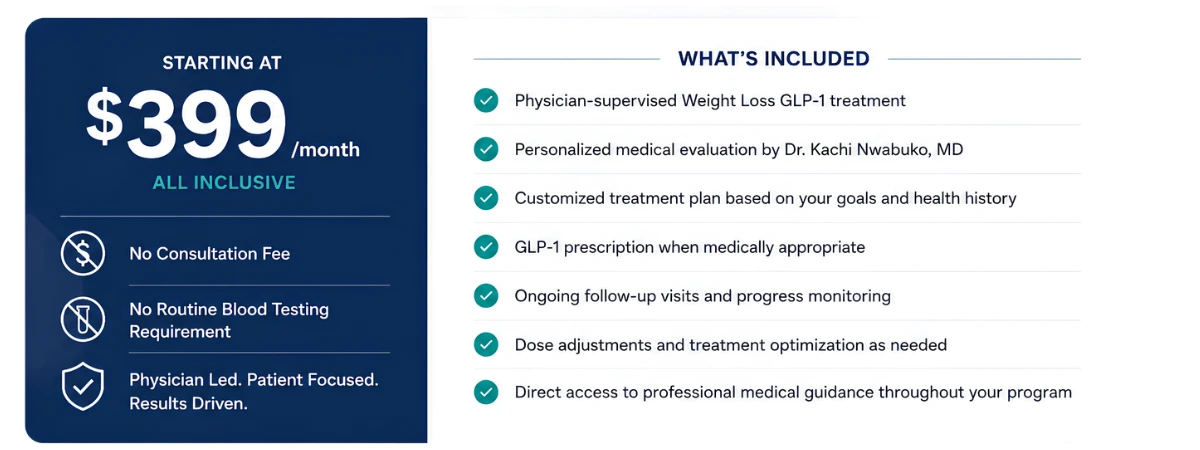
Affordable Physician-Supervised Weight Loss Starting at $399/Month

All-inclusive pricing. No consultation fee. No routine blood testing requirement. Personalized care from Dr. Kachi Nwabuko, MD.

FL Weight Loss Clinic - Diamond Medical San Antonio FL

What Is Semaglutide Weight Loss Medicine?

GLP-1 medications are a class of prescription treatments that help regulate appetite, support satiety, and improve blood sugar control. GLP-1 stands for glucagon-like peptide-1, a hormone involved in hunger signaling, insulin response, and digestion. For many patients, this can make it easier to follow a sustainable eating plan and maintain a calorie deficit over time.

A Semaglutide Weight Loss program may be appropriate when medically indicated and prescribed after a clinician review. Some patients may also be candidates for other FDA-approved GLP-1 or GLP-1/GIP medications depending on their medical profile and treatment goals.

Why Losing Weight Becomes More Difficult with Age

Many people assume weight gain is simply the result of poor willpower.
In reality, weight management is influenced by many biological factors, including:

Aging Icon
AGING
Genetics Icon
GENETICS
Hormones Icon
HORMONES
Metabolism Icon
METABOLISM
Sleep Quality Icon
SLEEP QUALITY
Stress Icon
STRESS

Why Medical Weight Loss Matters

Weight gain and difficulty losing weight are often influenced by biology, not just willpower. Hormones, insulin resistance, sleep, stress, genetics, medications, and metabolic health can all make weight loss harder. A Medical Weight Loss program addresses these factors with physician oversight rather than relying on a one-size-fits-all approach.

At Diamond Medical Clinic, the goal is not just scale reduction. The goal is better overall health, safer treatment, and a plan that can be sustained long term.

Semaglutide Weight Loss >>

Who May Qualify

GLP-1 treatment is not for everyone. During your consultation, Dr. Kachi Nwabuko, MD reviews your medical history, current medications, weight history, and health goals to determine whether prescription treatment is appropriate.

Eligibility is confirmed only after a clinician evaluates your health status and determines whether treatment is safe and appropriate for your condition. Contact us for more information.

You may be a candidate if you have:

  • A BMI of 30 or higher.

  • A BMI of 27 or higher with a weight-related condition such as hypertension, dyslipidemia, prediabetes, insulin resistance, sleep apnea, or cardiovascular risk.

  • A history of difficulty achieving or maintaining weight loss with lifestyle changes alone.

  • A need for physician-guided treatment with monitoring and follow-up.

Weight loss results vary by individual and are not guaranteed. Diamond Medical Clinic does not guarantee specific outcomes, rates of weight loss, or health improvements. Any patient testimonials or success stories reflect individual experiences and should not be interpreted as typical or expected results. A consultation with Dr. Kachi Nwabuko, MD, or other licensed healthcare provider at Diamond Medical Clinic is required before beginning any prescription weight loss program. GLP-1 medications, including semaglutide and tirzepatide, are prescription-only medications that require medical evaluation, ongoing monitoring, and clinical supervision.

Not all individuals are candidates for GLP-1 therapy. Treatment eligibility is determined based on medical history, current health status, medications, risk factors, and professional clinical judgment. Potential benefits, risks, side effects, contraindications, warnings, and alternative treatment options will be discussed during your consultation.

GLP-1 medications carry FDA-required warnings, including a potential risk of thyroid C-cell tumors. These medications should not be used by individuals with a personal or family history of medullary thyroid carcinoma (MTC) or Multiple Endocrine Neoplasia syndrome type 2 (MEN 2), unless otherwise determined appropriate by a licensed healthcare provider.

Telehealth services may be available where permitted by applicable federal and Florida law. A physician-patient relationship may be established through an appropriate telehealth evaluation. Prescribing decisions are made solely at the discretion of the treating healthcare provider and in accordance with applicable laws, regulations, and professional standards of care.

Ozempic®, Wegovy®, and Rybelsus® are registered trademarks of Novo Nordisk A/S. Semaglutide is a generic drug name and is not a trademark. Compounded semaglutide products are not manufactured, approved, or endorsed by Novo Nordisk A/S. Diamond Medical Clinic is not affiliated with, sponsored by, or endorsed by Novo Nordisk A/S.

Information provided on this website is for educational and informational purposes only and is not intended to constitute medical advice, diagnosis, or treatment. Use of this website does not establish a physician-patient relationship. (U.S. Food and Drug Administration⁠)

Free BMI Check ➜

Find Out If You May Qualify for GLP-1 Weight Loss

Discover where you stand on your weight loss journey with our free BMI calculator. In just seconds, you’ll receive your BMI result and learn whether you may qualify for FDA-approved GLP-1 weight loss treatment. It’s a simple first step toward better health and a more confident future before meeting with Dr. Kachi for your personalized consultation.

BMI Calculator
Use this calculator to check your body mass index (BMI).
BMI Calculator
Height
cm.
Please enter value between 125 and 225.
Weight
kg.
Please enter value between 10.0 and 500.0 ( one decimal ).
Height
ft.
in.
Please enter value between 4.2 and 7.3
Weight
lb.
st.
Please enter value between 22.0 and 1000.0 ( one decimal ).
Calculate BMI
Use this calculator to check your body mass index (BMI), which can be a helpful tool in determining your weight category. Or, use it to calculate your child’s BMI.


Meet Your Doctor

Your GLP-1 care is medically supervised by Onyekachi Nwabuko, MD, a family physician serving patients through Diamond Medical Clinic in San Antonio, FL.

Dr. Nwabuko reviews each patient’s medical history and determines whether a GLP-1 prescription is clinically appropriate. This includes evaluating weight-related health risks, current medications, blood sugar status, cardiovascular history, gastrointestinal history, and other safety factors before treatment begins.

Dr. Kachi Nwabuko Discussing GLP-1 Weight Loss Treatment With Patient During Medical Consultation in San Antonio Florida

How The GLP-1 Weight Loss Program Works

Your initial consultation with Dr. Kachi Nwabuko, MD, includes a comprehensive medical weight loss evaluation designed to review your health history, discuss your weight loss goals, determine whether you may be a candidate for GLP-1 therapy, and help you make an informed decision about your treatment options.

If prescribed, your personalized weight loss program may include medication dose adjustments, monthly follow-up visits in person or through telemedicine, nutrition and lifestyle counseling, individualized exercise recommendations, and ongoing medical monitoring to support your safety, progress, and long-term success.

Comprehensive Medical Evaluation

Meet with Dr. Kachi Nwabuko, MD, to review your weight loss goals, medical history, current medications, and overall health. We will assess your BMI and determine whether you may be a candidate for GLP-1 treatment.

Personalized Treatment Plan

If medically appropriate, Dr. Nwabuko will develop a customized weight loss plan that may include a GLP-1 prescription, lifestyle recommendations, nutrition guidance, and education on medication use, dosing, benefits, and potential side effects.

Ongoing Support & Monitoring

Your progress will be monitored through regular follow-up visits in person or via telemedicine. Treatment adjustments, dose optimization, and continued medical guidance help support your safety, results, and long-term success.
What GLP-1 Therapy May Help With

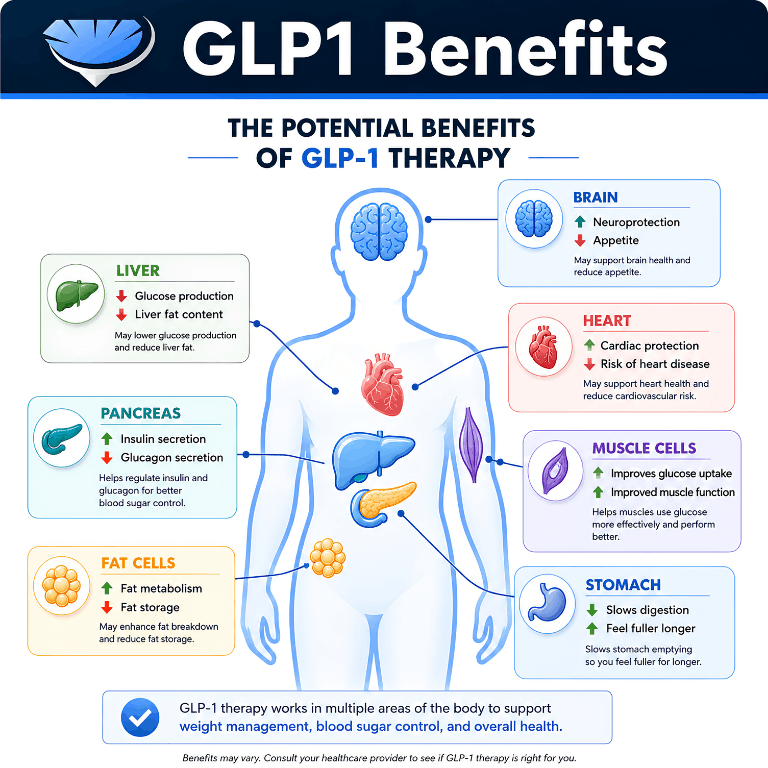
GLP-1 Weight Loss Benefits Infographic | FL weight loss clinic

Many patients seek GLP-1 treatment to support:

Individual results vary from patient to patient and depend on health status, age, starting weight, adherence, dose tolerance, lifestyle habits, and weight loss plan. Any patient experiences, testimonials, or examples presented are individual results and should not be interpreted as typical or expected outcomes.

Contraindications & Precautions

Your Health and GLP1 Safety Standards

GLP-1 medications are available by prescription only and should always be used as directed by your licensed medical doctor. Common side effects of GLP-1 medications may include nausea, vomiting, diarrhea, constipation, reflux, reduced appetite, and injection-site reaction

GLP-1 Side Effect Probability Table (below)

Side Effect

Probability / Incidence Rate

Key Source

Nausea

Approximately 50% of users (about half). RCT meta-analysis found 21.49% overall, with rates up to 31.7% for exenatide.

RAND Health Quarterly (2025); Frontiers in Pharmacology (2025)

Diarrhea

Approximately 33% of users (about one-third). RCT meta-analysis found 10.62% overall, with rates up to 15% for tirzepatide.

RAND Health Quarterly (2025); Frontiers in Pharmacology (2025)

Vomiting

Approximately 20% of users (about one-fifth). RCT meta-analysis found 9.10% overall, with rates up to 10% for lixisenatide.

RAND Health Quarterly (2025); Frontiers in Pharmacology (2025)

Constipation

Ranges from 7.92% to 30.4%. RCT meta-analysis found 7.92% overall, while a real-world cohort study reported 30.4%.

Frontiers in Pharmacology (2025); NIH All of Us Cohort Study

Reflux (GERD)

Risk ratio of 2.19 compared with placebo, equating to approximately 4 additional cases per 1,000 users. Also associated with a 27% increased risk compared with SGLT-2 inhibitors.

Gastroenterology (2025); Annals of Internal Medicine (2025)

Reduced Appetite

5.49% overall in RCT meta-analysis. Rates up to 10% with tirzepatide and approximately 5–6% with semaglutide and liraglutide.

Frontiers in Pharmacology (2025)

Injection-Site Reactions

Approximately 1–20% depending on the specific GLP-1 medication and formulation. Rarely result in treatment discontinuation.

Rethink Peptides (2026); Journal of Clinical Investigation (2026)

Table: (Above) GLP-1 side effects statistic probability data based on the most current published research [2024–2026 meta-analyses and large population surveys]. For more, visit our references section. #glp1-research-references

Additional Patient Information About GLP-1 Side Effects

  • Side effects are often dose-related: Gastrointestinal symptoms such as nausea, vomiting, and diarrhea tend to occur more frequently and with greater intensity at higher GLP-1 doses, particularly during weight loss treatment protocols.
  • Most symptoms improve over time: The majority of side effects are mild to moderate in severity and typically lessen as the body adjusts to treatment and dosing is gradually increased.
  • Symptoms commonly occur during dose increases: Side effects often begin shortly after starting therapy, frequently within the first few days, and are most noticeable during dose escalation phases.
  • Some patients may need treatment adjustments: A portion of patients experience side effects significant enough to require temporary dose reductions, treatment interruptions, or discontinuation under medical supervision.


GLP-1 treatment may not be appropriate for patients who are pregnant, breastfeeding, have certain thyroid conditions, a history of pancreatitis, severe gastroparesis, or medication interactions that make treatment unsafe. A medical consultation is required before any prescription is issued.

Frequently Asked Questions

What is GLP-1 weight loss therapy?

GLP-1 therapy uses prescription medication to help regulate appetite, increase satiety, and support weight loss under medical supervision.

How much weight can I lose?

Results vary. Your starting weight, health history, medication tolerance, and lifestyle habits all affect outcomes.

Who should not take GLP-1 medication?

Some patients should avoid it due to medical conditions, pregnancy, breastfeeding, or other safety concerns. A medical consultation is required.

Is GLP-1 therapy safe?

GLP-1 therapy is safe for patients only after a licensed clinician evaluates your medical history, medications, and risk factors.

Do I need to change my diet?

Yes. GLP-1 therapy works best alongside healthy nutrition, activity, sleep, and ongoing care.

Start Your GLP-1 Weight Loss Program in Central Florida Today

If you meet the clinical criteria above — or are unsure whether you do — a private consultation with Dr. Kachi is the clearest next step. Most patients receive a definitive eligibility determination and a personalized treatment plan at their very first visit.

Get Started with GLP-1 Weight Loss in Central Florida — Monthly Rates Available

References


  1. Cleveland Clinic. GLP-1 Agonists: What They Are, How They Work & Side Effects. Cleveland Clinic. Accessed June 22, 2026.
  2. Secher A, Jelsing J, Baquero AF, et al. The arcuate nucleus mediates GLP-1 receptor agonist liraglutide-dependent weight loss. J Clin Invest. 2014;124(10):4473-4488.
  3. Friedrichsen M, Breitschaft A, Tadayon S, Wizert A, Skovgaard D. The effect of semaglutide 2.4 mg once weekly on energy intake, appetite, control of eating, and body weight in adults with obesity. Diabetes Obes Metab. 2021;23(3):754-762.
  4. Almandoz JP, Lingvay I, Morales J, Campos C. Common GLP-1 questions answered by obesity medicine specialists. University of Utah Health. Published March 2026.
  5. López-Morales M, García-Montero C, López-Carmona MD, et al. GLP-1 receptor agonists for the treatment of obesity: Role as a promising approach. Front Endocrinol (Lausanne). 2023;14:1085799.
  6. Wilding JPH, Batterham RL, Calanna S, et al. Once-weekly semaglutide in adults with overweight or obesity. N Engl J Med. 2021;384(11):989-1002.
  7. Jastreboff AM, Aronne LJ, Ahmad NN, et al. Tirzepatide once weekly for the treatment of obesity. N Engl J Med. 2022;387(3):205-216.
  8. Shi Q, Wang Y, Hao Q, et al. Gastrointestinal adverse events associated with GLP-1 receptor agonists in overweight and obesity: A systematic review and network meta-analysis. Int J Obes (Lond). 2025.
  9. Zhang Y, Wang J, Liu X, et al. Comparative gastrointestinal adverse effects of GLP-1 receptor agonists: A systematic review and meta-analysis. Front Pharmacol. 2025.
  10. Meier JJ. GLP-1 receptor agonists for individualized treatment of type 2 diabetes mellitus. Nat Rev Endocrinol. 2012;8(12):728-742.
  11. Monami M, Dicembrini I, Mannucci E. Adverse effects of glucagon-like peptide-1 receptor agonists: A review of the literature. Expert Opin Drug Saf. 2017;16(5):589-600.
  12. Singh S, Chang HY, Richards TM, et al. Glucagon-like peptide 1-based therapies and risk of gallbladder and biliary disease: Systematic review and meta-analysis. JAMA Intern Med. 2022;182(5):513-519.
  13. Wharton S, Astrup A, Endahl L, et al. Estimating treatment effects of semaglutide 2.4 mg for obesity management across BMI categories. Obesity (Silver Spring). 2023;31(2):421-430.
  14. Rubino DM, Greenway FL, Khalid U, et al. Effect of continued weekly subcutaneous semaglutide vs placebo on weight loss maintenance in adults with overweight or obesity. JAMA. 2021;325(14):1414-1425.
  15. American Diabetes Association. Pharmacologic Approaches to Glycemic Treatment. Diabetes Care. 2025;48(Suppl 1):S181-S206.